Home / Custom Wiring Harnesses
Industrial components
Custom wiring harnesses
The harness offer is a build-to-drawing service: nine wiring harness records in the catalogue share one detailed specification, which means the service is standardised even though every harness is custom. Harnesses are produced to the customer's drawing and requirements, across an unusually wide application field — network and communication devices, automatic control, home appliances and office equipment, and automobiles, motorcycles and electric vehicles.
The recorded specification envelope
| Wire range | 10 AWG – 32 AWG |
|---|---|
| Wire standards | UL-listed types (incl. UL1007, UL1015, UL1061, UL1430, UL1571, UL2464, UL2468) or VDE |
| Wire options | Normal PVC wire; spiral or braid shield; halogen-free |
| Connectors | AMP, MOLEX, JST, PHR, FCI, Berg or equivalents, per customer requirements |
| Basis of manufacture | Customer drawings and requirements |
| Compliance (record) | RoHS compliant |
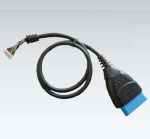
The OBD test wire and standard records
Alongside the nine general harness records, the catalogue lists an OBD test wire — the diagnostic-harness format for automotive programmes — and the patch cord family, which shares the same wire-and-connector discipline (see patch cords). Application-specific variants for ATV, home appliance, magnet ring and refrigeration equipment have their own page: automotive & appliance wiring harnesses.
How a custom harness order runs
- Send the drawing (or samples/pictures with specifications) — the customised-service procedure starts from these.
- Prototypes are prepared for your initial approval.
- Design-for-manufacturability feedback is returned so quality is controlled before mass production.
- Final samples and specifications are submitted for final approval, then production follows.
That four-step procedure is the company's published customised-service flow, and it applies across the OEM/ODM component families — combined plastic-and-metal structures, PCB assembly and terminal blocks or connectors with or without logo.
What wire gauges can you build?
The recorded envelope is 10 AWG to 32 AWG, in UL or VDE wire types, with shielded and halogen-free options.
Can you fit a specific connector brand?
The record names AMP, MOLEX, JST, PHR, FCI and Berg — or equivalents — fitted per customer requirements.
What do you need from me to start?
A drawing, or samples/pictures with specifications. Prototypes follow for your approval before production.
What a good harness enquiry contains
Harness quotations are won or lost in the enquiry. The enquiries that price cleanly contain five things: the drawing or a clear sample photograph, the wire specification (gauge per circuit and the UL or VDE type), the connector decision (named family, and whether equivalents are acceptable), the construction call (shielding, halogen-free, jacket), and the quantities with their ramp. Enquiries missing two or more of those come back as questions, not prices — which is fair, because a harness price without them is a guess wearing a number. The catalogue's customised-service procedure exists to close exactly those gaps in order: information, prototype, DFM feedback, final approval. Buyers who front-load the five items routinely skip a full round of the loop.
Samples are the contract
In harness work the approved sample is the real contract — the drawing says what was intended, the sample says what will ship. That is why the catalogue's procedure ends prototype approval with final samples and specifications signed off before mass production, and why experienced buyers keep a sealed golden sample on their own shelf as well. When a question arises mid-programme — a colour shade, a connector feel, a routing detail — the sample answers it in seconds, without a thread of archaeology through old emails. Treating the sample stage as a formality is the one economy this category reliably punishes.